How to Choose All Aluminum Interior Doors?
Choosing All-Aluminum Interior Doors requires more than comparing colors and prices. The right door must suit the room, wall structure, hardware, and daily use. A busy hallway needs stronger hinges and a stable frame. A bathroom needs finishes that tolerate humidity. A home office may need better sound control.
Gary Katz, a veteran door and hardware educator, puts the installation principle clearly: “The installation is part of the door.” That reminder matters. Even a well-made aluminum slab can rub, rattle, or close poorly when the opening is uneven. Measure the rough opening carefully. Check the wall thickness. Confirm swing direction, hinge positions, lock type, and frame depth before ordering.
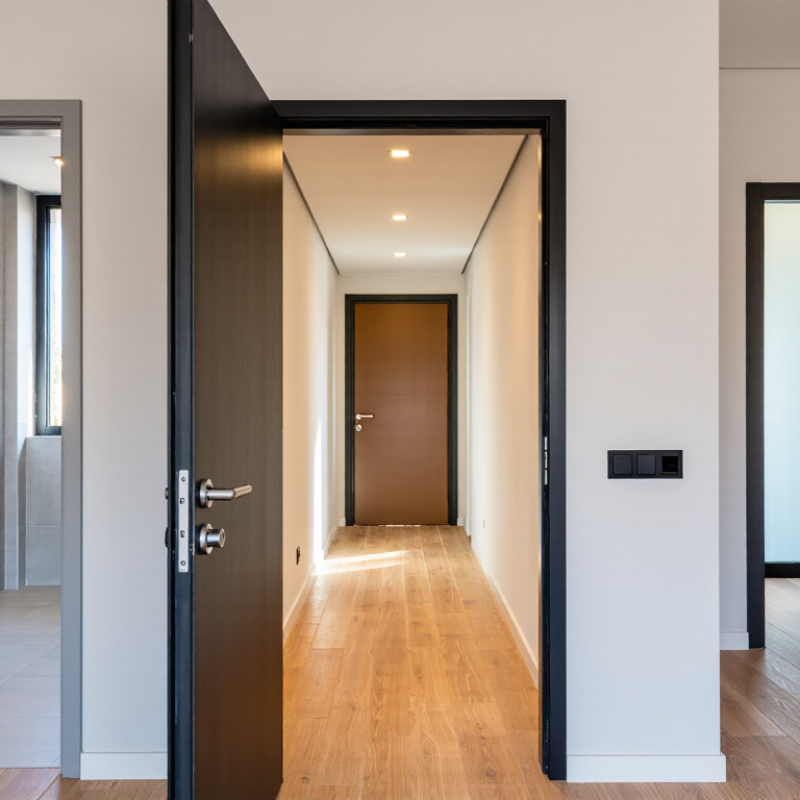
All-Aluminum Interior Doors offer useful advantages. They resist warping, termites, and ordinary household moisture. Their slim profiles can make a narrow corridor feel more open. Powder-coated surfaces also provide practical color choices, from matte black to warm bronze. Still, aluminum is not automatically perfect. Thin sections may transmit sound. Poor thermal breaks may create uncomfortable surfaces near conditioned rooms. Low-quality hardware can weaken the entire system.
Look for clear alloy information, tested finishes, accurate tolerances, and dependable installation support. Ask how the door performs after repeated opening and closing. Request samples under real lighting. A showroom finish may appear different beside oak flooring or white walls.
Some choices remain subjective. Minimal frames look elegant, but they may show alignment errors. Heavy doors feel substantial, yet they demand stronger hardware. This guide explores those trade-offs so you can choose All-Aluminum Interior Doors with confidence, not just attraction.
Define Interior Door Needs: Privacy, Acoustics, Moisture, and Fire Safety
Choosing an all-aluminum interior door starts with the room’s actual demands. Privacy is not only visual. A home office beside a bedroom may need controlled sound transmission. The World Health Organization recommends indoor bedroom noise below 30 dB for good sleep. Silence is measurable. Ask for laboratory-tested acoustic ratings, such as STC values, and inspect the seals, frame joints, and threshold. A strong panel cannot compensate for a poor perimeter seal.
Moisture changes the specification.
Bathrooms, laundry rooms, and coastal interiors expose doors to steam, splashes, and repeated humidity cycles. Aluminum resists swelling and rot, but hardware, coatings, and concealed joints still need protection. The U.S. Environmental Protection Agency identifies moisture control as a core part of healthier indoor environments. Water finds weak points. Specify corrosion-resistant hardware and a finish tested for the intended exposure, not merely a decorative surface.
Fire safety requires more discipline.
According to NFPA’s Fire Loss in the United States During 2023 report, fires caused approximately 1.5 million incidents and 16.5 billion dollars in direct property damage. An interior door should never be selected by appearance alone. Confirm the complete doorset’s tested fire rating, compatible frame, closer, hinges, and installation requirements. Ratings belong to assemblies. Do not guess. A minor gap, an altered lock, or an unapproved glass panel can undermine performance. Some specifications remain uncertain until the building authority and testing documents are reviewed.
Compare Aluminum Alloys: 6063-T5 Profiles Offer 2.7 g/cm³ Density
Choosing an all-aluminum interior door starts with the profile alloy, not its appearance. A 6063-T5 aluminum profile has a density of about 2.7 g/cm³, making it light enough for smooth daily operation. Its excellent extrusion performance creates clean edges, narrow frames, and consistent grooves for seals. The T5 temper also provides practical strength for residential and commercial interiors.
However, density alone does not decide quality. Many aluminum alloys share a similar density, while their strength, surface finish, and machinability differ. 6063-T5 is commonly preferred for visible door profiles because it produces an even surface after anodizing or powder coating. A 6061 alloy can offer higher mechanical strength, but it may be less convenient for detailed extrusion designs. For heavy doors or oversized panels, confirm the alloy, wall thickness, hinge capacity, and fastening method together. A light frame is useful. An undersized one is not.
Tips: Request the alloy grade and temper on the material documents. Check whether 2.7 g/cm³ refers to the alloy’s approximate density, not the complete door weight. Measure the profile thickness around hinge and lock areas. These sections experience repeated stress. Also inspect a sample corner for sharp edges, uneven coating, or loose joints. Small defects often become obvious after installation. I would not choose from a finish sample alone; real alignment matters more than a perfect showroom surface.
Evaluate Thermal Data: Aluminum Conductivity Is About 205 W/m·K
Choosing an all-aluminum interior door requires more than checking appearance or frame thickness. Architectural aluminum commonly conducts heat at about 205 W/m·K, according to alloy data referenced by The Aluminum Association. That figure is high. Copper is higher, while wood and polymer materials resist heat transfer far better.
This matters near air-conditioned rooms, stairwells, and heated corridors. A metal frame can quickly carry heat toward a cooler surface. ASHRAE Handbook—Fundamentals explains that thermal bridges can raise local heat flow and create colder interior surfaces. The door’s final performance depends on its U-factor, not conductivity alone. ISO 10077-1 evaluates frame, panel, glazing, and edge effects when calculating thermal transmittance.
Look for a tested assembly with a thermal-break detail. Polyamide separators, insulated cores, and sealed joints can interrupt the aluminum path. Small gaps matter. I would request laboratory U-factor data rather than accept a material-only claim. The U.S. Department of Energy also notes that air leakage can strongly affect real energy performance, even when insulation values look acceptable.
A practical check is simple. Stand near the closed door on a cold day. Notice drafts, cool frame edges, or condensation marks. This field observation is useful, but it is not a substitute for testing. One assumption deserves caution: thicker aluminum does not automatically mean better thermal efficiency. Design quality usually matters more than metal volume.
| Evaluation Item | Typical Value or Range | Unit | What the Data Means for an All-Aluminum Interior Door |
|---|---|---|---|
| Material Thermal Properties | |||
| Aluminum alloy thermal conductivity | Approximately 205 | W/m·K | Aluminum transfers heat rapidly. This is useful for heat dissipation but can create a thermal bridge when the frame is exposed to both warmer and cooler areas. |
| Thermal resistance of a 1 mm aluminum layer | Approximately 0.0000049 | m²·K/W | Calculated as R = thickness ÷ conductivity. A thin aluminum sheet alone provides very little insulation. |
| Low-conductivity insulation material | Approximately 0.020–0.040 | W/m·K | Common rigid insulation materials can provide far greater resistance than solid aluminum at the same thickness and may be used inside a composite door system. |
| Wood, depending on species and moisture | Approximately 0.12–0.20 | W/m·K | Wood is naturally less conductive than aluminum, although its thermal performance varies with density and moisture content. |
| Glass, typical soda-lime glass | Approximately 1.0 | W/m·K | Glass conducts much less heat than aluminum but still requires suitable glazing design to achieve a low whole-door U-value. |
| Door-System Thermal Performance | |||
| Uninsulated aluminum door or frame | Approximately 5.0–7.0 | W/m²·K | High heat transfer is likely because the metal forms a continuous conductive path. This construction is generally unsuitable where strong temperature separation is required. |
| Thermally broken aluminum door system | Approximately 1.5–3.0 | W/m²·K | A polyamide or other low-conductivity separator interrupts the metal path. The exact result depends on frame geometry, panel design, glazing, seals, and installation. |
| Insulated aluminum door leaf with continuous thermal break | Approximately 1.2–2.5 | W/m²·K | A suitable option when an aluminum appearance and durable surface are desired without relying on a solid aluminum panel for insulation. |
| Solid wood interior door | Approximately 1.5–2.5 | W/m²·K | Provides moderate thermal resistance, but performance depends on thickness, joints, moisture, and the surrounding frame. |
| Selection Checks | |||
| Thermal-break material thickness | Commonly several millimeters or more | mm | A wider and better-positioned thermal break generally reduces conductive heat flow, but the complete frame profile must be evaluated rather than the insert alone. |
| Door perimeter air sealing | Continuous compression seal recommended | — | Air leakage can reduce practical thermal performance even when the aluminum profile has a good calculated U-value. |
| Whole-door U-value | Use the tested or calculated value for the complete assembly | W/m²·K | U-value includes the frame, leaf, glazing, edge effects, hardware zones, and seals. It is more useful for comparison than aluminum conductivity alone. |
| Temperature difference across the door | Use the project design condition | K or °C | Heat flow increases as the temperature difference increases. Interior doors between similar-temperature rooms may need less thermal insulation than doors separating conditioned and unconditioned spaces. |
| Recommended decision rule | Prefer a thermally broken, insulated assembly when temperature control matters | — | Do not select an all-aluminum door based only on its material strength or appearance. Confirm the complete door U-value, thermal-break design, glazing specification, and air-sealing details. |
| Note: Conductivity values are representative engineering values and may vary with alloy, temper, density, moisture, temperature, and test method. Whole-door U-values are indicative ranges only; the manufacturer’s tested or calculated performance for the complete installed assembly should be used for final selection. | |||
Check Door Performance: Air, Sound, and Fire Ratings Against EN Standards
How to Choose All Aluminum Interior Doors?
Door appearance matters, but performance decides daily comfort. Check air permeability under EN 12207, where Class 4 provides the tightest tested performance. A tight door can reduce drafts around corridors, offices, and conditioned rooms. However, installation gaps can weaken a good factory result. Measure the wall opening carefully. Small errors matter.
Sound control needs evidence, not showroom claims. Ask for laboratory data tested under EN ISO 10140 and rated under EN ISO 717-1. The European Environment Agency reported that over 113 million Europeans faced road traffic noise above 55 dB Lden in 2020. Interior doors cannot solve outdoor noise, but a tested sound reduction value can improve privacy between bedrooms, meeting rooms, and workspaces. A 32 dB door may suit basic privacy; higher ratings need better seals, frames, and installation. Numbers alone are not enough.
Fire performance requires the complete door set: leaf, frame, hinges, closer, seals, and glazing. EN 1634-1 tests fire resistance, while EN 13501-2 classifies results such as E, EI, and EW. EI30 means integrity and insulation for 30 minutes under the tested configuration. Never assume aluminum is automatically fire-safe. The CTIF World Fire Statistics report shows how frequently fire incidents affect buildings worldwide, yet test conditions remain highly specific. Check the certificate scope. Hardware changes can invalidate it. That uncomfortable detail is often missed.
Verify Hardware, Finishes, Installation Tolerances, and Long-Term Maintenance
Choosing all aluminum interior doors requires more than comparing profiles and colors. Start by verifying the hardware specification. Check hinge capacity, latch alignment, handle clearance, and screw quality. A heavy door can expose weak hinges within months. I once underestimated this detail on a renovation, and the door began rubbing against the frame. It was a small mistake with an annoying repair.
Finishes need practical testing. Request a physical sample and inspect it beside the actual floor and wall materials. Powder-coated surfaces usually resist daily scuffs, but sharp objects can still damage their edges. Ask how the finish handles cleaning chemicals, fingerprints, humidity, and sunlight. Dark finishes often reveal dust faster. That matters in busy hallways. Avoid choosing only from a digital image. Screens can distort color.
Installation tolerances deserve equal attention. Confirm the opening width, wall plumb, floor level, and expansion allowance before fabrication. A skilled installer should measure several points, not just the center. Leave enough clearance for seasonal movement and hardware adjustment. Excessive gaps look careless, while tight gaps cause binding. Maintenance should remain simple: use a soft cloth, mild detergent, and dry the hardware afterward. Inspect hinges and latches every few months. Some advice sounds obvious, yet routine checks are often skipped. That is where reliable performance begins.
