What Are the Top Steel Column Radiator Types for 2026?
As 2026 approaches, the Steel Column Radiator is becoming more than a decorative heating choice. It now sits within a wider efficiency discussion. The International Energy Agency’s World Energy Outlook 2024 reports that buildings remain responsible for roughly 30% of global final energy consumption. Every emitter therefore matters, especially in homes with heat pumps or lower-temperature boilers.
Industry guidance also supports careful system matching. The UNEP Global Status Report for Buildings and Construction 2024 states that buildings consume about 32% of global energy and produce approximately 34% of global carbon emissions. Steel column radiators can respond effectively when their output, water volume, and operating temperature are correctly specified. Single-column models suit narrow hallways and compact rooms. Double-column designs offer stronger output without excessive wall projection. Triple-column and vertical options can help in larger rooms with limited horizontal space. Towel-style and low-water-content versions may also deserve attention in specific projects.
Hydronic heating educator Dan Holohan has expressed a useful principle: “The radiator is only one part of the system.” That reminder is easy to overlook. A beautiful radiator cannot compensate for poor balancing, incorrect pipe sizing, or an undersized heat source. The ranking is not absolute. Room insulation, window area, control strategy, and user habits can change the result. That is where this guide becomes practical, rather than merely fashionable. We will compare the top Steel Column Radiator types for 2026, examine their real-world strengths, and question where popular specifications may fall short. Some recommendations will remain imperfect. Heating design rarely rewards assumptions.
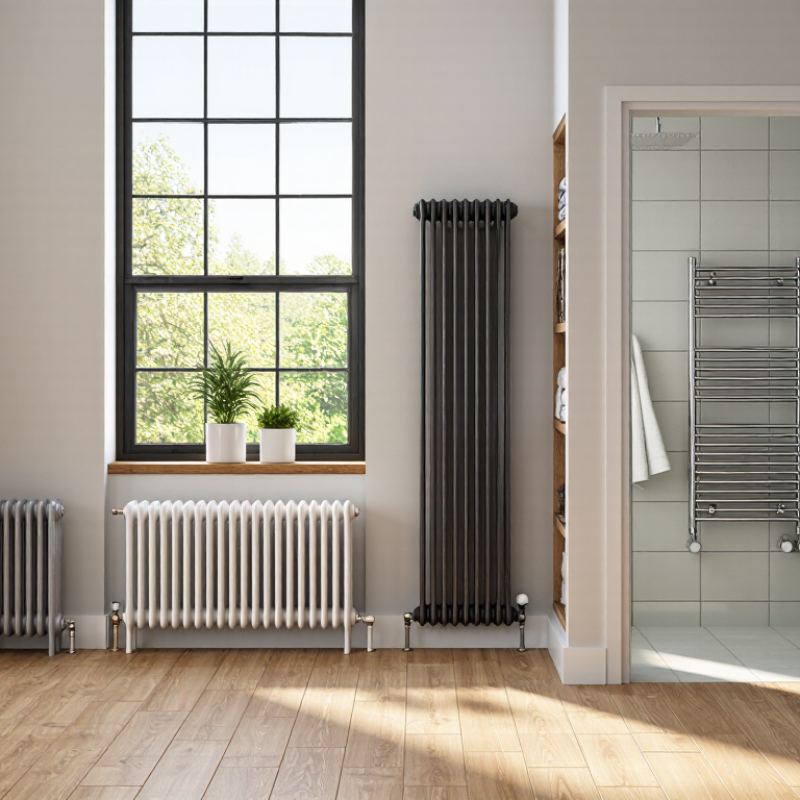
Steel Column Radiator Types Classified by Tube Count Under EN 442 and ΔT50
What Are the Top Steel Column Radiator Types for 2026?
Steel column radiators are commonly classified by the number of vertical tubes in each section. Single-column models have a slim profile and suit narrow hallways or compact rooms. Two- and three-column radiators provide stronger heat output without becoming excessively deep. Four-, five-, and six-column designs offer greater surface area for larger rooms, although they need more wall clearance.
Under EN 442, manufacturers test radiator output at ΔT50, meaning a 50°C difference between the average water temperature and room air. A typical reference condition is 75/65/20°C. The stated wattage helps engineers compare models fairly.
Tube count does not tell the whole story. Fin spacing, radiator height, section length, and connection design also affect performance. A four-column radiator is not automatically twice as powerful as a two-column model.
This shortcut sounds useful, but it is imperfect. In real installations, heat loss calculations should guide selection, especially near large windows or poorly insulated walls. Lower operating temperatures may also reduce output, so a ΔT30 rating can be more realistic for modern heating systems.
Tips: Check both the EN 442 ΔT50 output and the radiator’s actual dimensions. Leave space below and above the radiator for airflow. Measure pipe centres carefully. I would also compare the required output with a modest safety margin, rather than choosing the deepest model by appearance. A little calculation prevents an expensive mismatch.
Two-Column Radiators: Compact Designs for Rooms Requiring Lower Heat Output
Two-column steel radiators suit rooms needing moderate heat without occupying much wall depth. Their slim profile works well beneath windows, beside doors, or in narrow bedrooms. The lower water volume can also support faster response, although real performance depends on pipe sizing, controls, and insulation.
EN 442 rates radiator output at 75/65/20°C, giving a 50 K temperature difference. At 55/45/20°C, the difference falls to 30 K. Using the standard radiator exponent referenced in CIBSE Guide B1, output may fall to roughly half, depending on the model.
This matters in heat-pump homes. A two-column unit that performs adequately with a gas boiler may feel undersized at lower flow temperatures. The European Commission’s heating strategy also identifies space heating as a major share of household energy demand, making emitter selection more important than it first appears.
Check the certified wattage, not the number of columns alone. EN 442 test data and CIBSE heat-loss calculations provide a more reliable basis than a showroom estimate. Leave clearance around the radiator, especially below a deep sill, because restricted airflow reduces convection. I have seen compact designs chosen correctly on paper but installed behind furniture. That is an avoidable weakness. Sometimes, a slightly wider two-column radiator is wiser than a deeper model. Small rooms are not always simple rooms.
Three- and Four-Column Radiators: Balancing Surface Area, Output, and Footprint
For 2026, steel column radiators remain a practical choice for homes, offices, and renovation projects. Their key decision is not appearance alone. It is the balance between heating output, surface area, and available wall space.
Three-column radiators offer a useful middle ground. They provide strong heat transfer without projecting too far into the room. This suits bedrooms, hallways, and compact living areas. Four-column radiators contain more water and expose a larger surface area. They can deliver higher output from a similar wall length, but they usually extend further forward. That extra depth matters beside furniture, curtains, and narrow walkways.
Room surveys should include window size, insulation quality, ceiling height, and the position of external walls. I also check whether the heating system uses low-temperature water. Output ratings can change significantly under different operating conditions. Numbers can mislead.
In practical installations, a three-column model may fit neatly below a shallow window while still meeting calculated heat loss. A four-column version may reduce the required length, but it can create awkward clearances. Professional sizing should follow verified heat-loss calculations, not rough room-area rules. I have sometimes seen compact radiators selected too quickly, only to require higher water temperatures later. That weakens efficiency and comfort.
Valve placement, wall strength, and cleaning access deserve attention. Leave space around the radiator for airflow. Small details matter.
Six-Column Radiators: High BTU Output for Large Spaces at EN 442 ΔT50
What Are the Top Steel Column Radiator Types for 2026?
Six-Column Radiators: High BTU Output for Large Spaces at EN 442 ΔT50
Six-column steel radiators suit large rooms with high heat losses. Their extra water channels create more emitting surface within a practical wall width. Under EN 442-2 testing, ΔT50 means a 50°C difference between average water temperature and room air. This rating helps compare outputs fairly. It is not a promise for every installation.
CIBSE Guide B2 recommends room-by-room heat-loss calculations before selecting emitters. That advice matters in open-plan rooms, halls, and older properties with exposed walls. A six-column model can provide strong output, but depth, radiator length, and airflow still matter. Eurostat reported that space heating represented about 63% of EU household energy use in 2022. Better emitter sizing remains relevant.
At lower water temperatures, output drops sharply. Using the common radiator exponent of approximately 1.3, a ΔT30 system may deliver only about 51% of its ΔT50 output. The exact figure varies by design and testing. I have seen specifications treated like guarantees. That is a mistake. A long radiator may outperform a deeper one when wall space is available. Thermostatic valves, insulation, curtains, and furniture also change real performance. One detail is often missed: a powerful radiator cannot correct an underestimated room heat-loss calculation.
Top Steel Column Radiator Type for 2026
Six-column steel radiators provide strong heat output for large spaces. The reference values below show the estimated output of a 600 mm-high radiator at EN 442 ΔT50, converted from watts to BTU/h using 1 W = 3.41214 BTU/h.
How to read the chart: Longer radiators provide proportionally higher heat output when height, column count, and operating conditions remain consistent. Actual certified output can vary by radiator construction, connection method, and manufacturer testing.
Vertical and Low-Temperature Models: Performance at Heat-Pump ΔT30 Conditions
What Are the Top Steel Column Radiator Types for 2026?
At heat-pump ΔT30 conditions, radiator selection changes sharply. EN 442 ratings commonly use ΔT50, not ΔT30. Using the standard radiator exponent of about 1.3, output at ΔT30 is roughly 50–55% of the published ΔT50 figure. A three-column steel radiator usually performs better than a slim single-column model, because it provides more metal and convection area. Vertical versions save wall length, but their output depends heavily on height and airflow around the panels.
The International Energy Agency reports that modern heat pumps commonly deliver three to five units of heat for each unit of electricity. That efficiency falls when flow temperatures rise. CIBSE guidance also supports lower design temperatures where emitter capacity allows it. A practical design target is often around 35–45°C flow temperature, although ΔT30 may still appear in renovation calculations. Real rooms are untidy: furniture, curtains, and cold external walls can reduce useful output. I would not select a radiator from catalogue watts alone.
Tips: Ask for certified output at ΔT30, not only ΔT50. Check the room heat-loss calculation first. Choose a deeper three- or four-column model where wall space permits. For vertical radiators, keep the lower section clear of furniture. A small output margin helps, but oversizing every room wastes money and space. Verify valve compatibility with low-temperature controls.
What Are the Top Steel Column Radiator Types for 2026? – Vertical and Low-Temperature Models: Performance at Heat-Pump ΔT30 Conditions
Representative steel column radiator specifications and indicative heat output for low-temperature heat-pump applications
| Radiator Type | Typical Configuration | Nominal Height
(mm) | Approx. Depth
(mm) | Column Count | Indicative Output at ΔT50
(W/m) | Indicative Output at ΔT30
(W/m) | Water Content
(L/m) | Approx. Weight
(kg/m) | Heat-Pump Suitability |
| Vertical 4-Column Steel Radiator | High-output vertical format for limited wall width | 1,800 | 135 | 4 | 2,250 | 1,160 | 12.0 | 43.0 | Excellent |
| Vertical 3-Column Steel Radiator | Balanced depth, output and wall-space efficiency | 1,800 | 100 | 3 | 1,780 | 920 | 9.0 | 33.0 | Excellent |
| Vertical 2-Column Steel Radiator | Slim vertical installation for moderate heating loads | 1,800 | 65 | 2 | 1,300 | 670 | 6.0 | 23.0 | Very Good |
| Low-Temperature 4-Column Radiator | Deep horizontal format designed for high output at low flow temperatures | 600 | 135 | 4 | 2,050 | 1,060 | 11.5 | 41.0 | Excellent |
| Low-Temperature 3-Column Radiator | General-purpose high-output model for heat-pump retrofits | 600 | 100 | 3 | 1,600 | 830 | 8.5 | 31.0 | Excellent |
| Low-Temperature 2-Column Radiator | Compact depth with a good balance of output and clearance | 600 | 65 | 2 | 1,150 | 590 | 5.5 | 21.0 | Very Good |
| Compact 3-Column Radiator | Short-height option where sill or furniture clearance is restricted | 450 | 100 | 3 | 1,220 | 630 | 6.8 | 25.0 | Good |
| Compact 2-Column Radiator | Low-profile solution for smaller rooms and secondary zones | 450 | 65 | 2 | 880 | 450 | 4.5 | 17.0 | Good |
Technical basis: Values are representative engineering figures for welded steel column radiators and are shown per metre of radiator length. ΔT refers to the mean water-to-room temperature difference. ΔT30 output is estimated from the nominal ΔT50 output using a typical radiator exponent of approximately 1.30: Q30 ≈ Q50 × (30/50)1.30. Actual performance varies with radiator geometry, surface finish, connection arrangement, room temperature, flow rate and commissioning conditions. Final sizing should be based on certified EN 442 data for the selected radiator.
